What is Software Mining / Application Mining?
Software Mining / Application Mining is about source code analysis. Application source is the most detailed and up-to-date drawing of an application. Source code contains answers to many questions about the application and the business it supports.
Source code analysis has always been a core part of software development and maintenance but more or less methodical depending on the system developers tools and ways about it.
Not only system developers can benefit from source code analysis, roles like for example architects, DBA, project leaders, quality managers, system- and requirement analysts can find valuable information in application source.
Industry analysts have since a few years back given attention to the concept of Software- and Application Mining which includes both tools and methods for increasing the productivity by software analysis.
Software- and Application Mining can do what asset management tools, software documentation tools, software understanding tools, xref tools and advanced search tools do all together.
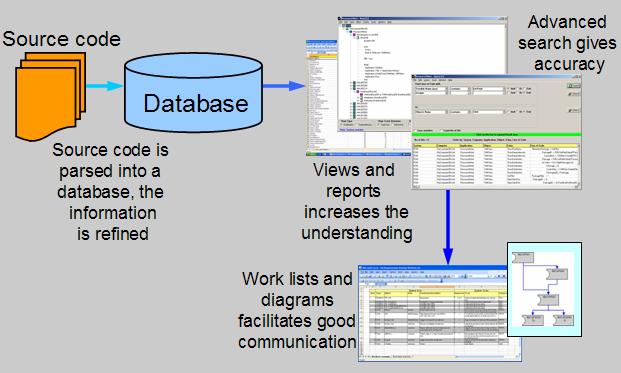
Software Mining / Application Mining is often described as the system developers equivalent of the business developers Data Mining. A database for Software Mining / Application Mining is a data warehouse (DW) for source code.
The source code is read and analyzed (parsed) into the database so that the information about the source code is refined.
The table structure of the database enables graphical views over one or several interacting systems also providing the user with powerful search capabilities.
The system developers can as the business developers 'drill' down to find golden nuggets burried in a sea of information.
Depending on tool, the database can hold only metadata about the source or the whole source.